Why Tamarindo Produces World-Class Yellowfin Tuna
I have been running charters out of Tamarindo for years, and if I had to pick one species that never gets old, it is yellowfin tuna. Not because they are easy — they are not. But because when you hook a big one, the whole boat changes. The reel screams, the rod loads up, and every angler on board forgets everything else they were thinking about.
Tamarindo sits on Costa Rica's North Pacific coast, directly adjacent to the Papagayo upwelling system — one of the most productive cold-nutrient currents in the Eastern Tropical Pacific. That upwelling drives massive baitfish concentrations: skipjack, bonito, flying fish, sardines. Yellowfin follow the bait, and the bait never leaves. Add in the continental shelf drop-off sitting 20 to 40 miles offshore, a network of FADs (fish aggregating devices) maintained in these waters, and the floating debris lines that accumulate along current edges, and you have a recipe for consistent, high-volume tuna action.
Guests regularly report 10 to 20 fish days. One group landed 12 yellowfin on their first day, including one fish pushing 100 pounds taken on spin and popper gear. That is not a lucky day — that is what these waters produce when you put in the work.
Yellowfin Tuna Seasons: Month-by-Month Breakdown
Yellowfin tuna are present in Tamarindo waters year-round, but there is a clear peak window and a clear slow window.
Peak Season: May through October (Green Season)
This is the primary tuna window and the reason serious tuna anglers plan trips during Costa Rica's rainy season. The Papagayo upwelling intensifies, baitfish stack up, and yellowfin move in numbers. Fish in the 30 to 150 pound range are common, and we encounter fish pushing 200 pounds during the heart of this window.
- May–June: Season kicks off. Fish appear offshore and around FADs. Excellent action on trolling and popping.
- July–August: Peak of the peak. Strongest bait concentrations, biggest fish, most consistent full-day action. This is when you target triple-digit yellowfin.
- September–October: Still excellent. Fish remain thick. Dorado often mix in as well. Seas can be rougher, but the fishing rewards anglers who go.
Shoulder Season: November and April
Transition months. Tuna are present but moving, and you need to work harder to find concentrations. These months reward anglers willing to cover ground. We often find fish in November near the FADs and around floating debris.
Slower Window: December through March
The dry season brings calm seas and great marlin conditions, but tuna move offshore to deeper, warmer water. They are still catchable — we find them — but counts are lower and targeting specifically for tuna is harder. If tuna is your primary target, avoid this window.
Where We Find Them: Fishing Grounds and Structure
Yellowfin tuna are not random. They follow structure, temperature breaks, and bait. Here is where we hunt them:
The Continental Shelf Drop-Off (20–40 Miles Offshore)
The bottom topography off Guanacaste drops from relatively shallow shelf into abyssal depths. That shelf edge creates an upwelling of cold, nutrient-rich water that collides with the warmer surface layer. That collision concentrates bait and, by extension, yellowfin. This is our primary hunting ground for the biggest fish.
FADs (Fish Aggregating Devices)
Costa Rica maintains a network of moored FADs offshore. These buoys attract baitfish and the entire food chain follows. We run to specific FADs based on which ones are currently producing — this changes week to week and we track it carefully. On a good FAD day, you can fill the box without traveling far.
Floating Debris and Weed Lines
Yellowfin love to congregate under floating objects — a log, a mat of sargassum, a piece of lumber. When we find a good debris line, we work it methodically. These spots can hold fish from 20 to 150 pounds stacked beneath the surface.
Dolphin Pods
When you see dolphin pods working offshore, there are likely yellowfin below them. Dolphin and large tuna have a well-documented association in the Eastern Pacific — they herd the same bait. We approach pods carefully and often find excellent popping or live-bait action underneath.
Techniques and Tackle for Tamarindo Yellowfin
High-Speed Trolling with Hard Lures
Our first search method. We run a spread of cedar plugs and skirted lures at 8 to 12 knots covering ground until we locate active fish. Cedar plugs in natural tones — white, pink, blue/white — produce well. Skirted lures in black/red or green/yellow are reliable attractor colors. This is how we find fish when we do not already know where they are.
Live Bait Fishing
Once we locate a concentration, live bait becomes the most effective method. We use bonito or skipjack as bait — sometimes the very fish we catch trolling become bait for bigger yellowfin. A live 3 to 5 pound bonito sent back without weight, free-lining it off the stern while the boat drifts, is one of the most deadly presentations for large yellowfin you will ever use. Big fish eat big bait. When we are targeting fish over 80 pounds, live bait is often our first choice.
Popping and Surface Lures
This is the method that gets anglers genuinely excited. When fish are pushing bait to the surface — a phenomenon called a "boil" — we cut the engines and cast poppers and stickbaits into the melee. A 150 gram popper worked aggressively across the surface, throwing water, can draw vicious strikes from yellowfin that are already in a feeding frenzy. The bite is visual, the fight is immediate, and the chaos of the boat during a surface blitz is something you do not forget.
Jigging
When fish mark on the sounder at depth and will not come up, we drop vertical jigs — typically 150 to 300 grams in chrome, blue, or pink — and work them with a fast, aggressive retrieve. Jigging is physically demanding but extremely effective when surface presentations are not getting bites.
What to Expect on a Tuna Charter: Hour by Hour
6:30–7:00 AM — Departure from Tamarindo Beach via water taxi. We board you from the beach, a quick 2-minute ride out to the boat. Crew briefs you on safety and gear while we run offshore.
7:00–8:30 AM — Transit to the fishing grounds. Use this time to eat breakfast, hydrate, and let the crew set the trolling spread. We are covering ground and looking for signs: birds, bait on the sounder, color changes in the water.
8:30 AM onward — When we find fish, the pace changes completely. We may troll through a school, trigger multiple hookups simultaneously, then switch to popping or live bait to keep fish engaged. On a productive day, you may fight fish continuously for 3 to 4 hours.
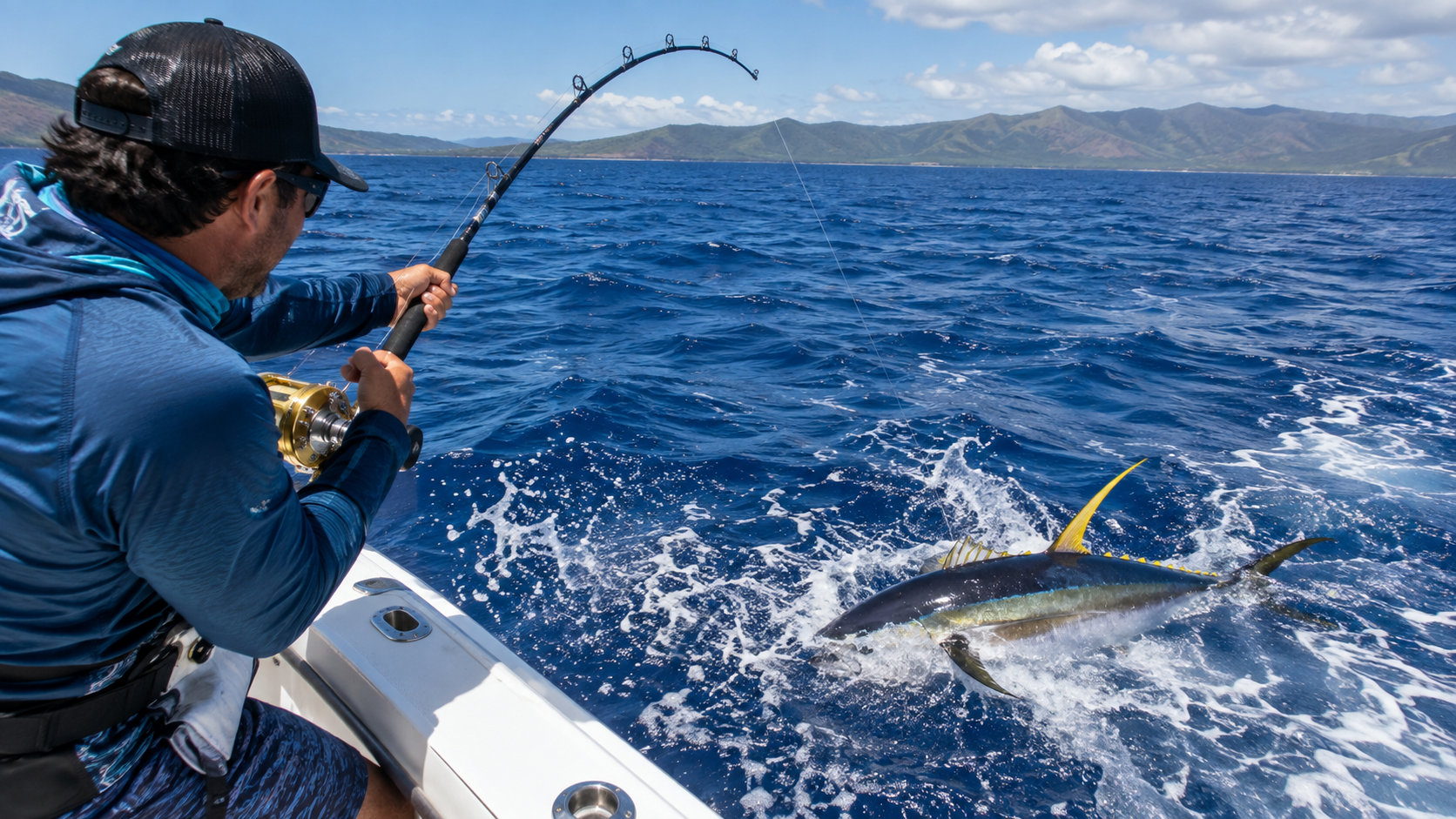
The Fight — A 60-pound yellowfin on 50-class tackle is a 10 to 20 minute fight that will have you questioning your life choices by minute 8. They run hard, they sound deep, and they use their body like a kite catching current — pure, grinding, lateral pressure. A 100-plus-pound fish can take 30 to 45 minutes of serious effort. Our crew coaches you through it, adjusts the drag, and calls the shots on when to pump and when to let it run.
End of Day — We return to the beach typically by 3:00 to 4:00 PM for a full day. The crew cleans and fillets your catch dockside. You leave with bags of sushi-grade tuna.
Eating Your Catch: Yellowfin Tuna from Ocean to Table
Yellowfin tuna is one of the finest eating fish in the ocean. We encourage guests to keep a reasonable number for the table and release the rest. Our crew fillets your catch on board, and we can bag it for transport.
Sashimi / Sushi — Slice against the grain, thin, serve with soy sauce, wasabi, and pickled ginger. A fish caught in the morning and sliced that afternoon has a sweetness and texture that no supermarket tuna approaches.
Seared Ahi — Season the loin with sesame seeds and coarse salt, sear in a screaming-hot cast iron for 45 seconds per side, slice thin. The center stays raw. This is the most popular preparation among our guests.
Poke — Cube the tuna, toss with soy, sesame oil, green onion, and whatever you have. Several Tamarindo restaurants will make poke with your catch.
Cook Your Catch — Several restaurants in Tamarindo will prepare your fresh fillets for you. You caught it in the morning; you eat it that evening with a cold beer. Read our guide on restaurants that cook your catch in Tamarindo.
Which Boat to Book for Tuna Fishing
Coyote Tres — 35 ft, Twin 500 HP Cummins Diesels
This is our offshore workhorse and my first recommendation for yellowfin tuna. The twin Cummins diesels make the 30 to 40 mile offshore run efficiently, and the larger deck gives you room to fight fish, store live bait, and work multiple anglers simultaneously. If we are running to distant FADs or hunting the shelf edge, Coyote Tres is the right call. Full-day from $2,000.
Flamingo II — 31 ft Center Console
An excellent option for tuna within 20 to 30 miles offshore, or when you want a faster, more agile platform for popping and jigging. The center console layout gives anglers 360 degrees of fishable deck — ideal for casting poppers into a surface boil from any angle. Full-day from $1,450.
Both boats depart from Tamarindo Beach via water taxi. Check our fleet page for full specs.
Tips for Landing Big Yellowfin
- Keep the drag tight from the start. Yellowfin have hard mouths. You need to drive the hook home immediately.
- Never give free line. If a yellowfin runs at the boat, reel fast. Slack line loses fish.
- Use your hips, not your arms. On a long fight, pump with your whole body. Your arms will fail you on a 100-pound fish.
- Trust the crew on drag adjustments. As the fish tires, we may increase drag. This is intentional.
- Stay calm during the first run. 200 yards of line gone in 30 seconds is normal. Hold on and let the drag work.
- Stay hydrated. Fighting fish is cardio. Drink water before you feel thirsty. Dehydration causes you to lose fish.
- Watch the color change. When you see blue water turn green under the boat, the fish is close. Get ready for a final surge.
FAQ
What is the best month to fish for yellowfin tuna in Tamarindo? July and August are consistently the most productive months, with the highest fish counts and largest average size. May, June, September, and October are also excellent. December through March is the slow window for tuna specifically.
How big do yellowfin tuna get in Tamarindo? We regularly see fish in the 30 to 150 pound range. Fish over 100 pounds are caught every season. The IGFA all-tackle record is 427 pounds. Costa Rica produces fish in the 150 to 250 pound class, though fish of that size are exceptional.
Do I need to bring my own tackle? No. All rods, reels, lures, terminal tackle, and live bait are included in your charter. If you have personal poppers or jigs you prefer, you are welcome to bring them.
Can I keep the fish I catch? Yes. Yellowfin tuna are excellent eating. We encourage guests to keep a reasonable quantity for the table. Our crew fillets and bags your catch at no additional charge. We practice strict catch-and-release for all billfish.